
Search This Supplers Products:wire rodwire rodprepainted galvanized coilpc wirehot rolled steel plate/striproof roll forming machine
Steel sheet pile walls
sourceJUNNAN NEWS
publisherGloria
time2026/01/20
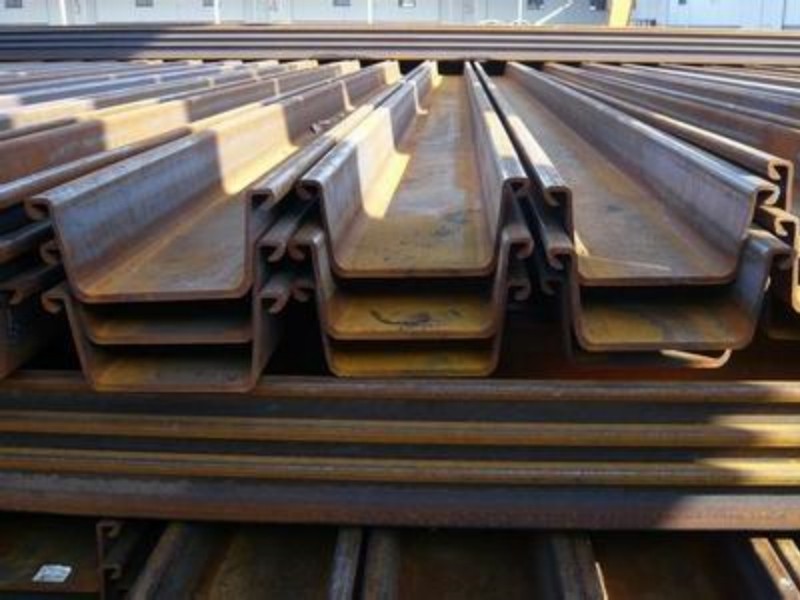
- Steel sheet pile walls are constructed by driving steel sheets into a slope or excavation.
Steel sheet pile walls are constructed by driving steel sheets into slopes or excavation areas. They are most commonly used for temporary deep excavations. When it is necessary to retain high lateral pressures in soft soil, steel sheet piles are often considered the most economical option.
One key advantage of steel sheet piles is that they can be driven to depths below the excavation bottom, effectively controlling heave in soft clay or piping in saturated sand—situations that soldier piles cannot address, as soldier piles are more permeable.
However, steel sheet piles are more expensive and less adaptable to difficult conditions, such as encountering large boulders or irregular rock surfaces.
Because soil displacement is relatively small, clay, sand, and silty clay mixtures generally provide favorable driving conditions for steel sheet piles. However, in weak soils, larger displacements may occur, and effective drainage is usually required, as the piles themselves do not create a watertight barrier.
Leakage typically occurs along the interlocks between soil particles, which can lead to consolidation in organic soils and soft silty clays (compressible materials). For sandy soils, if the interlocks are tight, bending of the sheet piles does not occur. However, driving steel sheet piles into loose sand may induce settlement.
Anchor
Following the installation of steel sheet piles a small excavation is made along the wall and the first row of anchors is installed. The trench is only made wide enough for the anchor installation machine and the excavation-anchor sequence is repeated until the bottom is reached.
Well constructed anchor walls undergo less lateral deflection than braced walls and so provide a better control of backslope subsidence. Anchor installation only requires a small excavation to allow equipment access. However for braced wall installation there is often a requirement to excavate below the level of support.
Anchored walls are always pre stressed which essentially removes the slack from the system. The anchors will maintain their load throughout the excavation sequence unless creep occurs. The anchors also place the entire soil mass between the anchors and the wall in compression, thus creating a very large gravity wall.
There are two causes of loss of subsidence for anchor systems:
· caving of the anchor holes prior to grouting
· flow of cohesion less material into the excavation through wall openings made for anchor installation
Other disadvantages include possible downward movement of the wall due to the vertical component of the anchor forces.
Propped
Propped walls may have one of more levels of prop in the upper part of the wall. They can be designed to have fixed or free earth support at the bottom and derive their stability from the props. They are common in cofferdams.
For propped walls in the free earth condition the penetration of the piles should be such that the passive pressure in front of the piles will resist forward movement of the toes of the piles but will not prevent rotation. The piles are supported by ties at the top of the wall and the soil at the base of the wall.
In fixed earth conditions further penetration of the pile is required to ensure that not only the passive pressures in front of the wall resist forward movement but also that the rotation of the toe is restrained by the passive pressures located near the toe at the rear of the wall